News CENTER
新闻中心

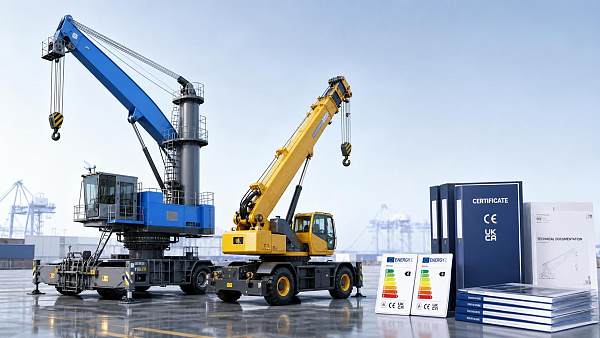
Effective June 15, 2026, Indonesia will mandate the local Green Energy Efficiency Certification (GEEC) for all imported cranes—a regulatory shift driven by the newly issued SNI 8426:2026 standard, jointly published by the National Standardization Agency (BSN) and the Ministry of Energy on May 28, 2026.
Key Regulatory Facts
The mandatory SNI 8426:2026 standard requires that all cranes imported into Indonesia undergo and pass the locally administered Green Energy Efficiency Certification (GEEC) starting June 15, 2026. Certification testing covers four technical parameters: no-load energy consumption, variable-frequency motor efficiency, brake energy recovery rate, and noise emission (capped at ≤78 dB). Products failing to obtain GEEC prior to customs clearance will be prohibited from entry. A transition period of only 17 days was granted between the standard’s issuance (May 28) and its enforcement date.
Impact Across Supply Chain Roles
Importers and Export Trading Firms
These entities face immediate compliance pressure: GEEC is now a binding customs prerequisite. Failure to submit valid certification at the time of declaration will result in shipment rejection or detention—directly affecting cash flow, contractual delivery timelines, and penalty exposure under Incoterms® clauses such as DAP or DPU.
Raw Material and Component Suppliers
Suppliers providing motors, inverters, braking systems, or acoustic-dampening materials must ensure their components meet GEEC-related performance thresholds. Downstream manufacturers may require updated test reports or component-level efficiency data to support full-system certification—shifting technical documentation responsibilities upstream.
Crane Manufacturers and Assemblers
Manufacturers exporting to Indonesia must revalidate product performance under Indonesian test conditions—not just factory-rated specs. This includes verifying real-world brake energy recovery rates and noise levels under specified operating conditions, potentially requiring design adjustments or third-party validation at accredited Indonesian labs.
Logistics and Compliance Support Providers
Freight forwarders, customs brokers, and certification consultants must now integrate GEEC verification into pre-shipment checks. Documentation workflows—including test reports, lab accreditation evidence, and BSN-recognized certification body letters—must be verified before vessel loading or air cargo release.
Critical Actions for Exporting Enterprises
Confirm Certification Body Authorization
Only laboratories and certification bodies officially recognized by BSN may issue GEEC. Verify current authorization status via BSN’s public registry—not relying on historical CE or ISO/IEC 17065 accreditations alone.
Validate Test Parameters Against SNI 8426:2026
Do not assume equivalence with IEC 60034 or ISO 12100. The standard specifies unique test protocols—for example, brake energy recovery must be measured during controlled deceleration cycles under loaded conditions, not simulated in software.
Adjust Procurement and Delivery Timelines
Given the 17-day transition window and typical GEEC lab turnaround (often 3–6 weeks), enterprises should treat certification as a non-negotiable milestone in order planning—not a post-shipment activity. Delays risk missing Q2 2026 project windows.
Update Technical Documentation Packages
Include Indonesian-language summaries of test methodology, calibration certificates for measurement instruments, and traceable energy metering logs. BSN inspectors may request these during pre-clearance audits.
Industry Perspective: Beyond Compliance
Analysis shows this measure reflects a broader regional trend: Southeast Asian markets are shifting from safety- and structural-focused standards toward integrated energy performance mandates. What deserves closer attention is how GEEC’s noise and recovery-rate criteria effectively raise technical barriers beyond legacy efficiency metrics—favoring manufacturers with inverter-grade control architecture and regenerative braking integration. From an industry perspective, the compressed timeline suggests limited capacity at accredited Indonesian labs, increasing reliance on pre-submission technical reviews and potential bottlenecks in Q2 2026.
Strategic Takeaway
This regulation marks a structural inflection point—not merely a procedural update. It signals Indonesia’s intent to align infrastructure equipment imports with national energy transition goals, embedding sustainability requirements directly into market access rules. For global crane suppliers, GEEC is less about passing a one-time test and more about institutionalizing energy performance validation across R&D, procurement, and quality assurance functions.
Source Notes
This article synthesizes information provided in the user input: title, event date (2026-06-15), and event summary. Specific official source links were not provided in the input and should be verified continuously. Stakeholders are advised to monitor upcoming BSN technical circulars, GEEC implementation guidelines, and updates from Indonesian customs authorities regarding document formats, lab recognition lists, and transitional interpretation of ‘existing orders’.